Elizabeth Zott
Lessons in ChemistryElizabeth Zott is a chemist, teacher, and television presenter whose career exposes the distance between scientific ideals and the institutions that claim to uphold them. Dismissed from the Hastings Research Institute because she is pregnant and unmarried, she creates a laboratory in her kitchen and later teaches chemistry on Supper at Six. Her movement between laboratory and television does not resolve the conflict between scientific work and gendered expectations; instead, she makes that conflict visible, insisting that women are capable of understanding the rules that govern the physical world and the value of the work they do.
Identity and Scientific Work
Elizabeth’s sense of herself is grounded in scientific work. She approaches chemistry as a way to understand how things function, and she resists the idea that technical knowledge belongs only in laboratories or to people authorized by institutions. Her later research interest is abiogenesis, the origin of life. When Roth visits her home, she explains the subject in detail, shares test results and interpretations, and makes clear that she is a chemist rather than simply a cooking-show host. Her explanation gives the abstract research a public language without reducing its complexity.
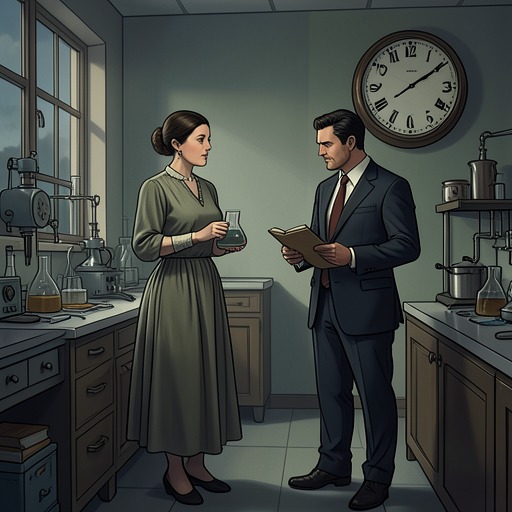
Her home laboratory makes that commitment material. It takes about four months to transform the kitchen. Shelves hold chemicals, flasks, beakers, pipettes, siphon bottles, litmus paper, medicine droppers, glass rods, empty mayonnaise jars, nail files, a backyard hose, and tubing salvaged from an alley trash bin behind a phlebotomy lab. The former utensil drawers hold acid- and puncture-resistant mitts and goggles; metal pans under the burners help with alcohol denaturation, and a used centrifuge supplies equipment she cannot otherwise readily access. The space is not a symbolic substitute for scientific work: it is where she continues working despite the loss of her institutional position and the limits of what a home can accommodate.
That limitation is apparent when she discusses the malfunctioning centrifuge, the impossibility of a home cyclotron, and city zoning restrictions on installing radioactive equipment. Her account combines resourcefulness with the practical barriers around it. The laboratory allows her to continue research, but it cannot reproduce every facility or permission available to an established institution.
Dismissal and the Rebuilding of a Career
Dr. Donatti pushes a termination notice across a table and tells Elizabeth that she has put the institute in a terrible position. When she challenges the decision, he states that women do not continue working while pregnant and calls her unmarried pregnancy disgraceful. Elizabeth rejects both the moral judgment and the premise that pregnancy makes her unsuitable for scientific work. She points out that he would not have fired Calvin Evans and argues that he has no technical grounds for treating her differently. Dr. Donatti’s response makes the double standard plain: he falls back on the fact that she is a woman who has become pregnant.
Elizabeth’s answer is characteristic of her method. Rather than meet his disapproval with embarrassment or melodrama, she treats the claim as an argument that can be examined and disproved. The room’s silence follows her refusal to concede that the men judging her possess sounder reasoning. She sees particular irony in facing moral gatekeepers inside a building devoted to science, and she leaves the meeting with a sharpened awareness that institutional authority and rational judgment are not the same thing.
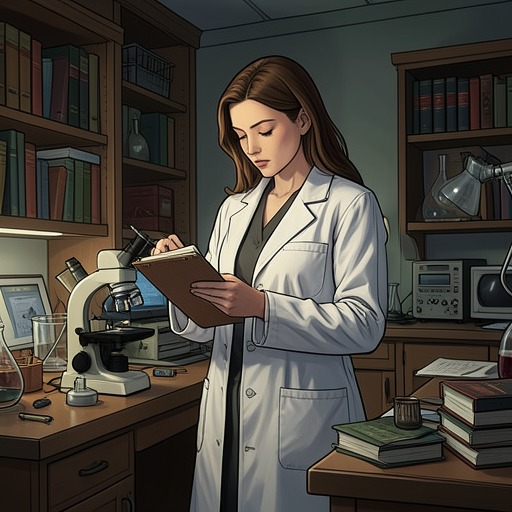
Afterward, she builds the kitchen laboratory and later returns to the Chemistry Department, where her return is marked by a new lab coat. That renewed institutional presence does not end the conflict over ownership of her work. When Dr. Donatti’s paper appears in Science Journal, Elizabeth recognizes the research as hers: the article draws directly on her files and lists her as a co-contributor. The publication turns the earlier professional inequality into a question of credit as well as access. She has found a way back into scientific work, but the institution still permits another researcher to present her results under his authority.
Teaching Chemistry on Television
Walter Pine approaches Elizabeth after a difficult day and pitches a cooking show for afternoon television. She agrees to appear on Supper at Six, opening the broadcast by introducing herself and welcoming viewers to her kitchen. The setting gives her a platform beyond the laboratory, but she does not treat cooking as a retreat from science. She uses recipes and food to explain chemical processes, presenting practical instruction as a route into questions about how matter works.
On one broadcast, she explains the role of water molecules in the chemical bonds that give a piecrust stability and structure. From that example she turns to the work of maintaining a home, calling it an enormous responsibility that is undervalued even though it holds things together. The connection is more than a metaphor for domestic life: it lets her address viewers through a familiar task while refusing to treat that task as intellectually trivial. The studio audience’s vigorous response shows that the lesson has reached listeners as both chemistry and recognition.
A question from Mrs. George Fillis of Kernville makes that recognition especially concrete. Thirty-eight years old, she says she enjoys the program and has learned from it. Remembering Elizabeth’s explanation of osmosis, she wonders whether the concept might help explain her leg edema. Her husband has disparaged her intelligence, and she initially describes herself as merely a housewife, though she reads medical journals. Elizabeth refuses the diminishment in that description and asks what else she does. The exchange treats the viewer not as a passive recipient of simplified information but as someone capable of following a scientific idea into a question about her own life.
Elizabeth later explains to Roth why she wanted to use Supper at Six to teach chemistry: when women understand atoms and molecules, they can begin to see that some of the limits imposed on them are false. In this account, television is not a replacement for research or simply a performance. It is a way to make scientific understanding available to women whom conventional institutions often fail to recognize as serious thinkers. The program’s domestic setting becomes a point of entry into scientific reasoning rather than evidence that its host belongs only in the home.
Grief, Responsibility, and Self-Judgment
In a conversation with Roth, Elizabeth’s scientific identity proves difficult to separate from her personal history. She brings him to her laboratory because she wants readers to understand that she is a chemist, and she explains that the origin of life was the problem she had been pursuing. When Roth asks about Calvin Evans, she reacts as though he has broken an assurance. Her reluctance establishes a boundary between the work she is ready to discuss and the loss he wants to probe.
She eventually tells Roth that she considers herself entirely responsible for Calvin’s death, describing the accident, the leash, and the sirens. Her statement is an account of her own burden of guilt, not a neutral verdict on the circumstances. She connects that guilt to a wider series of decisions and losses: after Dr. Donatti steals her research, she gives up her work; trying to help her daughter fit in, she enrolls her in a school where she does not fit; and she believes she has become the kind of performer she least wanted to be, like her father. She counts Phil Lebensmal’s heart attack among the consequences of her life only to distinguish it from the others, saying she does not regard that as a failure.
The conversation also clarifies the force of a promise she has made never to hold anyone back. In her telling, grief has not remained confined to the event of Calvin’s death; it has become a rule by which she judges later choices. That rule helps explain both her determination to keep working and the cost of the detours she has taken. Her television career lets her teach at scale, but she also measures it against the research she left behind, revealing how public success can coexist with private regret.
Departure from Television and Return to Research
When Elizabeth announces her decision to leave Supper at Six, she tells viewers that she has enjoyed hosting the program but intends to return to scientific research. She thanks the audience for its viewership and friendship, and recalls the hundreds of meals made together over two years. She then insists that the work has produced more than supper: the studio audience rises in agreement. Her departure is therefore not a repudiation of the program. It marks the importance of what she and her viewers have accomplished while making clear that she wants to resume the work that first defined her.
The emotional response around the announcement draws together the relationships that have sustained her television life. Harriet Sloane embraces Elizabeth and Walter Pine, sharing in the moment as the audience responds. Walter, watching from the producer’s chair, remembers meeting Elizabeth when she strode past his secretaries in a white lab coat. He recalls that what had impressed him was not simply her appearance but her confidence and certainty, which had taken root in others. His memory frames her influence as something transmitted: the authority she claimed for herself helped other people recognize their own.
After the announcement, representatives discussing the future of the Hastings Research Institute tell Elizabeth that they will need an inventory of every laboratory and ask what she would need for her research there. They specifically identify her abiogenesis work as a reason she might return. Elizabeth’s response is guarded; she can think of several places she would prefer. The offer does not settle her next step, and the ending preserves her ability to choose rather than treating institutional recognition as automatic reconciliation. Her decisive movement is the announcement itself: after using television to teach chemistry and affirm women’s intellectual lives, she openly recommits to scientific research.